AddThis

2/25/04

Home______The Sky and The Mill Near Wijk

I once lived in the Netherlands. It is a fine country, with pleasant canals, and green fields reaching to polders. I lived in Gouda and commuted to Rotterdam. Each morning I looked in on my sleeping daughter, said goodbye to my wife, and headed out of town, across the draw bridge, and toward the highway. I turned on the radio and listened to news and talk shows as I drove, sipping the coffee I had carried out the door of the house. One morning I heard a Dutch professor interviewed about a growing concern in Europe, American Cultural Imperialism, as it was called. The term struck me, and I listened to the professor develop his argument that Europeans in general and Dutch in particular must be on guard against the cultural hegemony foisted over them by the United States. It was feared as an invasion of sorts--movies, music, television programs, books, even cultural icons. It was not only cultural, but economic, a way of living, an acquisitiveness, a materialism that was taking over society.

After I had lived there for a while and got to know more Dutchmen, I realized that the average person had other concerns which had to do with daily living, not any American cultural or economic imperialism.

This came to me as I improved my command of Dutch. In part, it came because I found it difficult to practice the language. I would walk into a shop and in accented Nederlands asked for something and the response inevitably followed in English. Almost everyone spoke it. School courses of up to five years in English were required.

When I asked a storekeeper why so much emphasis on English, I was told that it was a matter of economics. English was the dominant business language in the world today. I asked, Doesn't this ability to understand English also heighten a fondness for, and acceptance of, foreign things? Doesn't it quicken the absorption of other cultures, goods, and points of view, and especially things American because of the volume of imported U.S. goods?

Yes, but people live in a global economy, he said. English was necessary to grow and survive and prosper.

But what about its influence on what I heard called American imperialism?

Ah, well, said the storekeeper, That was another matter, one best left to the professors to discuss. It was how they earned their own livings--by thinking about society and lamenting what was happening to it.

Yes, a steady American flotilla of goods, ideas, and images, sailed on a commercial tide to Europe and Holland but so, too, were markets opening everywhere else. As one instance, jobs increasingly left American shores for places like China and India. The imperialism, it seemed to me, was not American. It was of history, of time as we know it, of an entire world in competition to move toward growth economies. It was an accidental imperialism, one that nobody intended but which everyone becomes ensnared in. It was called The Twentieth Century. In developed countries, most people steadfastly regard it as an age of relief for the common man and time for his entry into affluence. I had no quarrel with any of that. I just wondered about what we had forgotten or had never known.

I looked at a lovely windmill perched along a canal as it turned slowly in the wind. Its blades caught the rising sun as they passed their zenith. Drivers sped along the canal road, encased in glass and metal, listening to a rock station or morning news. They might glance at the windmill and briefly think that it was pretty and then they braked for the bridge, drawing up for a barge to pass underneath. They glanced at wrist watches to see if they would be late to the office.

After I noticed drivers passing the windmill, hardly glancing at it, I was reminded of what I had read about forest natives in Brazil. I thought of breeze along a jungle river and of the Amahueca Indians of the upper Amazon. They gathered evenings and discussed the day as it had passed. A hunter described the sounds a jaguar made. He talked about the animal's mood. Another tribesman noted the greenness of the foliage and that a certain plant was growing in an area. A band of howler monkeys had moved on to another part of the forest. Some birds settled in the trees over by the river and hadn't moved for days. Somebody mentioned that the wind had shifted several times during the day and carried a strange smell in it whenever it blew from up river. They discussed the personality of plants which gave off strange vibrations that they could feel as they walked by.

After I had thought a few weeks about imperialism, economic and cultural, I decided that I would read The Education of Henry Adams to my daughter when she was older. Henry Adams, the author, a grandson and great grandson of U.S. Presidents, narrated a visit to the Great Exposition of 1900 in Paris where he was drawn to the huge gallery of machines. There he looked upon forty foot dynamos which became for him a symbol of ultimate energy, inhuman, that man had unleashed. With such machines he had fear for the future of humankind.

In 1884 Hiram Stevens Maxim invented the machine gun in England. He harnessed the steady and progressive burning of the propellant, which released gases that drove the gun mechanism. He held the trigger down and it fired eleven rounds a second.

The Maxim gun changed the course of World War I. It was largely responsible for the men, horses and mules left to rot on the fields of France. The Allied and Central Powers had anticipated quick victories and a war soon over but the machine gun forced soldiers of both sides into trenches and it kept them huddled there. Trained two feet above the mud, it could shoot the knees off anything that moved.

Henry Adams had feared the future and at the Paris Exposition he walked in the galleries which manifested what would become a new view of normalcy. He was not sure if it would become the right view or not, but he beheld it all through a crystal ball of his imagination and didn't feel assured by what he saw.

I could tell my daughter that from one perspective, despite the Maxim gun, another machine, an economic one, gained awesome strength so that today the common man continues to be better off than his peasant forbears, and he considers it his normal lot. I would say it to reassure her of a future yet uncertain.

I would say, Yes, there have been other machines: nuclear bombs and the one fed by Zyklon B. I would not add that it is also true that the economic engine demands more fuel of human spirit but so far, I would say to myself, we are better off if we don't think too much about what sanity might mean.

I would talk to her about the dynamo Adams saw in Paris among those gentlemen with top hats and frock coats as they escorted ladies with bustles and parasols. Modernity can be traced to that thing, not to economic imperialism. The machine had been created by people who didn't know that instead future generations would serve it. I would say that Adams was right to fear it, but it is what we have and now we find it hard to look at the world any other way than through technology and the money it brings.

American cultural imperialism, the Dutch professor complained, is bringing the country down. At the Rijksmuseum in Amsterdam I found a painting by Jacob van Ruisdael, once attributed to Duurstede. It is titled The Mill Near Wijk and shows a great sky of dark, ominous clouds moving over a windmill, a boat and three tiny women in the right foreground.

As I gazed at the painting I was drawn into it and asked myself if the sky Ruisdael had seen was like what Henry Adams saw in the future, for the one in the picture swelled beyond its borders and did not warn of a storm merely. It hid the sun and threatened the people below with something far beyond their dreams and fears.

It seemed to look out of the past to suggest an age when no one could seriously paint like that again. It implied a time when the natural could no longer be represented because nobody could be sure what nature meant. Entire cultures would think that way. Henry Adams and the Dutch professor were implied by that sky. My wife and daughter were in it. So was I.

Home

2/7/04

Home______In Memory of Carlie Brucia

Carlie Brucia has been on my thoughts lately. Abducted, then raped and murdered, she died as nobody should, especially not an eleven year old. The video surveillance camera shows her being quietly led off, her hand in the man's, as if adult authority is not to be challenged. This is a powerful, disturbing, scene, and one that reaches into human nature itself.


In my youth I met André Gide one semester. His novel, The Immoralist, introduced me to existential philosophy, which raised the concept, If God is dead, then everything is permitted. As my father would say, it was Tom-Foolery, but I didn't know it then. Wherever I walked, metaphysically speaking, my feet straddled a seismic fault, and I sought solid ground. After while, though, I discovered that I really was after an escape from the world as I found it.

Each minute, each hour, each day, a Carlie is somewhere ripped from the safety of father, mother, and siblings, and plunged into horror. No wonder that she did not struggle at first. The furniture of society conspires to promote the illusion of home. We have traffic lights, policemen, law, order. We have popcorn at movies, TV sit-coms, football games, and family dinners. When little Carlie was led away, she was probably fearful, but obedient to the illusion.

The social fabric is tissue-thin, sustained by the illusion. We laugh at Jay Leno, scorn Saddam Hussein, as we watch their phosphate images on television screens. They are social constructs, thousands of miles away; yet they are closer in mind than our next door neighbors, many of whom we do not know. Let the economy collapse, nuclear holocaust erupt, and see how quickly the constructs disappear.

Brutally, suddenly, Carlie Brucia discovered that the world is not as it seems. A father myself, I feel her parents' anguish when I think of her. Despite years of sordid news events, I still ask Why?

Covering the trial of the Nazi Adolph Eichmann, Hannah Arendt coined a phrase, the banality of evil, and it has become her legacy to our understanding of murders such as Carlie's. Evil is almost always banal. We must remain vigilant and not assume that it always looms as a large warning. WH Auden said it well: "About suffering they were never wrong, the old masters: how well they understood its human position: how it takes place while someone else is eating or opening a window or just walking dully along; how, when the aged are reverently, passionately waiting for the miraculous birth, there always must be children who did not specially want it to happen, skating on a pond at the edge of the wood. . . ." (Musée des Beaux Arts)

At this moment as you read these words, somebody somewhere is raped, murdered, robbed, tortured, or discovers a cancerous tumor.

Like the bumper stickers proclaiming Shit happens, so does evil. We think of it as monstrous, satanic in proportions, its quintessential image the jetliners slamming into the World Trade Center. But it is banal--trite, common-place, everyday. The Al Qaeda terrorists smiled at the lady when they checked out of the hotel. They said thank you to the ticket agent at the airline counter. A neighbor describes Joseph P. Smith, arrested for killing Carlie, as playing with his three daughters, buying them a puppy, building them a goldfish pond.

In a post-modern, deconstructionist, world, the term evil may sound outmoded, but I believe it exists. I must believe so. Otherwise, things make no sense to me. I cannot shrug away the horrible fate of Carlie as tough luck.

Carlie's is the world as I find it and it must be faced.

Albert Camus' The Plague is about fight, not against disease, not against German soldiers, but against indifference to human suffering.

Camus believed that in each of us a spark of goodness smolders, which we can choose to fan into flame, and with this novel he develops his belief. For Camus, actions define the man and the citizens of his novelistic city have defined themselves into meaninglessness.

The people of Oran, Algeria, are alienated from one another. In torrid summers, they stay indoors, shutters closed, each turned in on himself. "The truth is that everyone is bored, and devotes himself to cultivating habits. Our citizens work hard, but solely with the object of getting rich." Involved in his own concerns, each is removed from society and the common welfare. Life is ennui, meaningless. The plague changes everything. It offers people a chance to regain meanings.

Like evil, an epidemic belongs not to a person but to communities. Evil for Camus is indeed a plague and something we must fight against. We cannot doubt it exists. As the townspeople gather together they discover new meaning; their lives are shaped by belief in the good of community and hatred of the plague.

Tarrou, an outsider, cannot stand to see human suffering ignored by the masses. To correct this, he gathers sanitary squads, formerly complacent men now eager for difficult daily jobs. Tarrou explains, "All I maintain is that there are on this Earth pestilences and there are victims, and it's up to us, so far as possible, not to join forces with the pestilences."

That is my belief and with every news item about Carlie Brucia I am reminded of it.

Home

1/28/04


Home______Napoleon at 35,0000 feet

In a DC9 at 35,000 feet. Looking down on vast plains of clouds. Layer upon layer of them, nimbus, cumulus. Hurts the eyes, like snowblindedness. The cabin is very light inside. The clouds are real but we fly right through them, like a thought through the mind.

At the National Gallery I saw a larger-than-life portrait of Napoleon by Jacques-Louis David. The Emperor stood before me, the weight of his countenance heavy on history. Over there in that cloud I see his torso lying in state. The nose, the high forehead, the eyelids drawn.

David had captured the man, but which is the greater likeness? That cloud or his portrait?

Home

1/15/04

< The way it never was. An art photo of labor.


Home_____Dad & Freudian Arbeit

Father's hair had receded to the sides with a few strands brushed over the top when one day he retired. For over fifty years he had bent to the daily grind, supporting his family as electrician, a trade he learned on the battleship Connecticut in the first war. He worked until age sixty seven. Each morning he listened to the radio of his Ford as he drove to his job at the Lawrence Radiation Laboratory in the hills above Berkeley, California. The news was his chief interest. Songs didn't stick to him, a practical man who determined early in life that the labor of his hands and feet, not any penchant for pretty lyrics, would get him through it. One song he did like, though, was Sixteen Tons, a Hit Parade tune and South African ballad popularized by Tennessee Ernie Ford. "You load sixteen tons and what do you get? Another day older and deeper in debt." To my father the lyrics bespoke the dignity of manhood, of providing for others, of strength in the face of grim daily reality, of holding his head high.

Most of the other songs he heard were Tin Pan Alley fluff about Paper Moons and White Sport Coats and Pink Carnations but this song was about hanging tough, about a world that ground people into grit and muscle and left little time to think about romantic nights and gossamer clouds.

Father stuck it out for mother and his family and grew older, trying hard not to get deeper in debt. He and mom scrimped and saved for their retirement.

Sir Edmund Hillary said he climbed mountains because they are there. My dad worked because it is a thing set like the pattern of moon and stars. You do it because it is what a man does.

He had dreams as a youth. Their residue emerged when he spoke of the "big shots" at the Radiation Lab, the scientists and managers who wore suits and ties and walked around talking, which to my father was their task rather than using their hands to oil an electric motor.

Later, I read Freud's discussion of arbeit, work, as a key means to growth and self-mastery in life. I smiled at this as I thought of dad. Freud had a wholly different perspective than his. In Freud's own life, creative imagination and intellectual development were central and for that reason he believed that successful arbeit provides a sense of competence and allows personal maturation. He saw in work, modern professional work, a main hope for people. I thought of father who was proud of having a job but it seemed to wear him down rather than build him up. As a therapist, Freud observed his patients and thought in terms of individual fulfillment for the Viennese affluent rather than of how few paychecks in society could support such occupation.

Dad stuck with the program for his family. He never saw a shrink, nor did it occur to him that he needed one. A therapist might have given him greater insight into his own motivations and complexities and the parents within, who kept him as a child in chains, but he had responsibilities and that was that. He would have not known what to make of Freudian psychiatry, which began a new age and atmosphere. In this privileged air the individual sought to free himself from parental and social expectations, to cast out skeletons in mental closets, to seek self-realization even if it meant forsaking obligations. Freud's discussion of work was interesting but dad's background gave me an awareness that went unmentioned by the doctor. Austrian fathers dug for coal in unsafe mines and Austrian mothers took in wash to pay for their children's breakfast while gentlemen and ladies lay on the doctor's couch to take the talking cure.

Freud's was a rather limited view of work, a view proscribed by the marked division of labor in industrial society and he sat on the comfortable side of the line. Dad showed me that that a job often had more of the sense that Studs Terkel gave it in Working, a collection of tape-recorded narratives from many people, fry cooks to executives: "This book, being about work, is, by its very nature, about violence--to the spirit as well as to the body. . . . It is above all (or beneath all) about daily humiliations. To survive the day is triumph enough for the great many of us."

That is the common reality of arbeit. Its country has no patriots. Its citizens are worn into compliance and they hope only for the winning lotto number.

Home

12/13/03

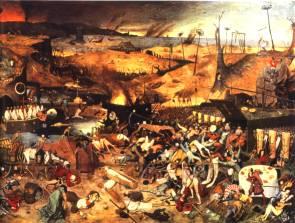
Brueghel: The Triumph of Death

Home______Remembrance of A Death Foretold

This blog has meandered from breezy humor to philosophical speculation, from political commentary to consciousness questions. A thread runs through all the articles, the thread of persona. Each tone reflects a different color of my personas. From the ancient Greek, persona literally refers to masks actors used when playing tragic or comedic roles. Ergo, personality, which is our composite of masks. We are not only the lover, the husband, the parent, the executive, the employee, the cop, the professor, the doctor, the lawyer. In a sense, we are these roles and also the values, morals, emotions and feelings behind the masks while the speaker conveys this inner condition to the world.

Who is the speaker behind these masks? Dawn rises on our lives and we glory in the fresh sun, the roseate sky. In our childhood we are golden lads and girls without a care for speakers or masks. Life offers itself and we take it. Soon, very soon, we become professor, doctor, lawyer, cop, roles foisted upon us by the world as we find it. By middle age some of us have become duped into believing in our masks or else we consider ourselves imposters.

Which brings me to my story.

Several years ago I received a letter from an old navy buddy. He and I had corresponded for years, and so when I took his letter from the mailbox I looked forward to reading it. I walked back to the house, the sun warm on my back, the breeze rustling tree leaves. The day had been good. The evening promised a pleasant dinner with my wife and a stroll through the neighborhood as streets revealed shadows, lengthening toward night.

When I opened it in my house I had to sit down, for his letter wasn't just about himself. It was about our common destiny, his, yours and mine. It was about the heaviness that each of us carries within. Here is part of the letter. I have changed his name.

You may wonder why you've not heard from me recently. Many of the normal reasons apply--busy, new projects, hectic life, etc. What wasn't normal for Wesley R. Andersen was a period of weakness and illness that wouldn't go away.

By the time it bothered me enough to force me to a doctor, by the time they put me through the requisite tests, by the time a prognosis was reached, it was malignant, untreatable, and terminal.

By the time you read this, my last letter, I'll be gone and my ashes will be scattered in the North Atlantic Ocean.

You may wish we could have talked one last time, but I didn't need the sympathy--I needed time to clean closets, both metaphorically and literally. You may have missed an opportunity to express sadness, but I needed the mind-set to get ready for my final day.


With the letter was a note from his wife. It said that he had died Saturday morning while resting on the couch.

The death of others is like an astronomical datum. The day he died Wes was spinning at 836 miles an hour around the earth's axis, or 64,800 miles an hour around the sun. Wes's pain and departure were there but I didn't notice them any more than I noticed our common velocity through space. Poet W.H. Auden said that the painters of old were never wrong about suffering and death. Breughel painted Icarus falling out of the sky, while a farmer had his field to plow, and so plowed calmly on. Suffering and death take place while someone else is eating or opening a letter.

As I compose this article, I read Wes's letter once again. It invokes not the man whose ashes are scattered on the waters, but the fellow I once knew, young, eager for his life to come.

His years crept into middle age and the life to come went. When I first read his letter, I resisted an impulse to pick up the phone to call him and see if it wasn't all a giant hoax. After it sank in, I was reminded of Hemingway's comment in A Farewell to Arms: against all the high-sounding words, truth, honor, country, patriotism, duty. One fact remains. You die. You die alone.

When Wes died, I thought of all that had remained for him. He looked forward to working on his antique car. As a reunion coordinator, he anticipated the annual gatherings of our old aircraft squadron. That was part of his public persona. I also knew some of his private masks, one of an orphaned child cast upon foster parents who threatened him with Hell and damnation if he didn't become Born Again. He had his own struggles.

From his ashes I raised some questions. His wife lost a husband. I lost an old friend. He lost himself. Himself. What was the self that he lost? What was behind his personas? Who was their speaker?

The questions are not only about Wes. They are about everybody. Whoever, whatever, he was, only Wes knew and now he is gone.

All things are on fire, said Buddha. They burn with desire, hatred, illusion, birth, old age, death, mourning, misery, grief, and despair. The eye is on fire, as are forms, thoughts, sensations. Thus the world consumes itself. Scientists call it entropy.

This is called The Fire Sermon and seems to have little to do with us. After all, where's the fire? We feel no heat, see no fumes. No, not us.

We commute to work, resolved to get the promotion, finish the project, become a better parent, not cheat on the spouse. We look at the buildings we pass, edifices of public authority, proclaiming that this is the world, that it is right and fitting to bend our lives to the edict. Sometimes we stop to ask if the lie doesn't penetrate deeper, but then we shake our heads as if caught dreaming, and we scurry to the elevator to get off at the ninth or tenth or eleventh floor.

At home, the question of the lie returns before we fall asleep. We glimpse the lie of authority; listening to the nightly news, watching the commercials, we ask Is this the Good Life? But we nod off in our easy chairs, dreaming that when we retire things will get better. Better always means when. When wealthy, healthy, happy. Better always allows us to postpone the questions, Who am I? , What is the lie? Am I just John Doe, husband, father, entrepreneur; am I only dedicated, loving, ambitious, methodical, rational, or impulsive? Is it merely the lie of authority, conformity, normality, or sanity?; of capitalism or communism or democracy or autocracy?

Did Wes have answers to these questions? I don't know. He certainly didn't believe in the world as he found it. He retired from the navy and followed his own path. He was unusual in that regard, career military on the one hand and a maverick on the other. Anyhow, he is gone, and his wisdom left with him.

As I said, the questions are not only about him, but also about everybody. For the rest of us, life continued on the day he died. Nobody except his wife and family noticed. That's why the matter is about us. We are all self-referential. Yet Earth spins through the black infinitude of space while we comport our daily affairs as if nothing unusual is happening. We dream on, despite the millions of births and deaths each day. We don't bother to ask important questions because they don't occur to us, or if they do, we think we have more urgent and pressing concerns.

They get considered only if we make them pressing. The world offers distraction enough to postpone them for the rest of our lives. Then we wind up with cancer or pass peacefully in our sleep. Either way, we don't postpone any longer.

Wes was somewhat familiar with W.H. Auden, although I don't know the extent of his knowledge. Perhaps Auden was a solace to him; at least I like to think so. The poet can give us pause. He reminds us of the lie, of the truths we avoid. That's why I will close with him. He provokes thought, even in the casual reader. Auden offers a filter for our modern world, one which helps us see our way to a few of the questions which need asking. Here it is--

The Unknown Citizen
(To JS/07/M/378 this marble monument is erected by the state)

He was found by the Bureau of Statistics to be
One against whom there was no official complaint,
And all the reports on his conduct agree
That in the modern sense of an old-fashioned word, he was a saint,
For in everything he did he served the Greater Community.
He worked in a factory and never got fired,
But satisfied his employers, Fudge Motors, Inc.
Yet he wasn't a scab or odd in his views,
For his Union reports that he paid his dues,
(Our report on his Union shows it was sound),
And our Social Psychology workers found
That he was popular with his mates and liked a drink,
And that his reactions to advertisements were normal in every way.
. . .
Our researchers into Public Opinion are content
That he held the proper opinions for the time of year;
When there was peace, he was for peace; when there was war, he went.
He was married and added five children to the population,
Which our Eugenist says was the right number for his generation,
And our teachers report that he never interfered with their education.
Was he free? Was he happy? The question is absurd:
Had anything been wrong, we should certainly have heard.
  • W.H. Auden

    And so I leave you with the biting sarcasm, the irony, of that last line.

    Home